|
Sungjun Yun I am an Integrated M.S./Ph.D. student in Computer Science at Yonsei University , where I am a graduate researcher at the Edge AI Lab, advised by Prof. Dong-Jun Han. My research focuses on trustworthy AI, particularly confidence calibration, continual learning, and parameter-efficient adaptation. My long-term goal is to build trustworthy AI models that are safe and interpretable: models whose internal behavior we can understand, that know when they are wrong, and that remain reliable as they continue to adapt. Email / CV / Google Scholar / GitHub |
|
News🌟 Sep 2026 — Our paper MT-CC is accepted to NeurIPS 2026 as a Spotlight! 📝 Sep 2026 — Our paper on concept-separated diffusion unlearning is accepted to NeurIPS 2026. 🎓 Mar 2025 — I started my Integrated M.S./Ph.D. at Yonsei University and joined Edge AI Lab, advised by Prof. Dong-Jun Han. 🎓 Feb 2025 — I received my B.S. in Computer Science from Soongsil University. |
ResearchI am interested in building reliable machine learning systems that remain well-calibrated as they continuously acquire, modify, and forget knowledge. My current research studies how model adaptation changes the relationship between prediction correctness and confidence, especially in large language models and continual learning. |
Publications |
|
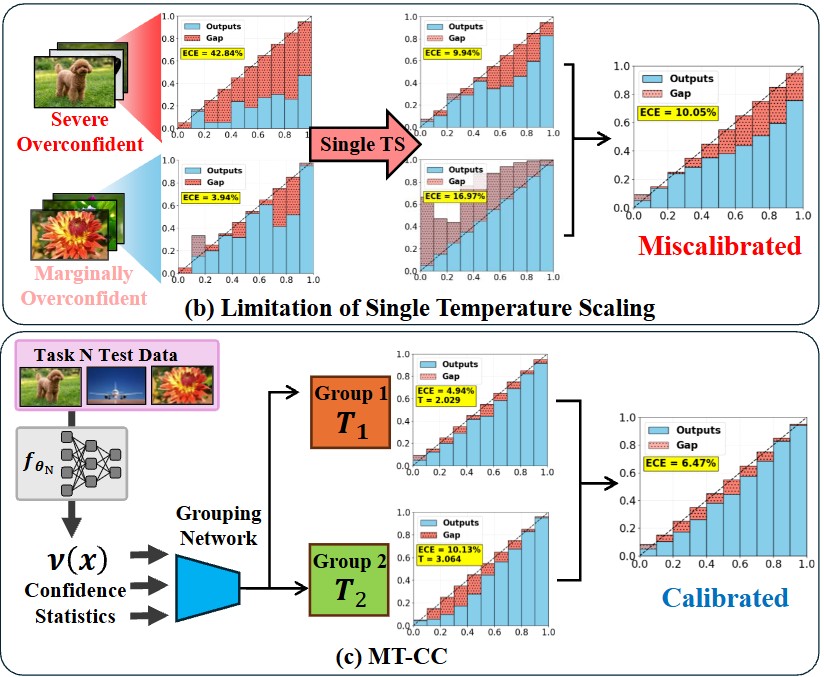
MT-CC: Multi-Group Temperature Scaling for Asymmetric
Calibration Behavior in Class-Incremental Learning
Sungjun Yun, Yonghee Choi, Dong-Jun Han NeurIPS 2026 (Spotlight) arXiv / code A multi-group calibration framework for handling heterogeneous confidence distortions that emerge throughout class-incremental learning. |
|
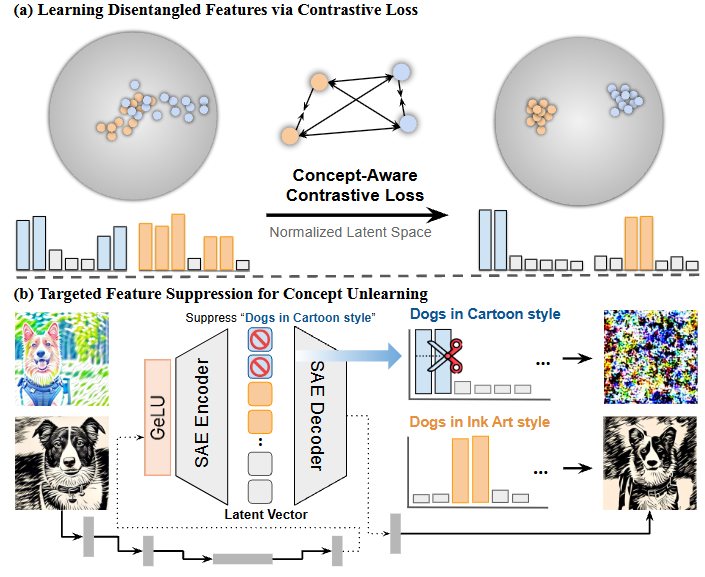
Disentangled Sparse Representations for Concept-Separated
Diffusion Unlearning
Hyeonjin Kim, Hangyeol Jung, Heechan Yun, Sungjun Yun, Dong-Jun Han NeurIPS 2026 arXiv Studying disentangled sparse internal representations for fine-grained concept manipulation and unlearning in diffusion models. |
Education
Yonsei University
Soongsil University |
| © 2026 Sungjun Yun |